 11

Great AI Rotation 2026: The stock market is sending a confusing message to investors.
The S&P 500 remains close to its recent record highs. But beneath the surface, a significant number of individual stocks are facing serious pressure.
According to a recent analysis highlighted by Goldman Sachs trader Bobby Molavi, approximately 60% of S&P 500 constituents have entered bear market territory, even while the broader index remains relatively strong. This has been described as a “stealth bear market.”
At the same time, investors are beginning to question one of the biggest investment themes of recent years: artificial intelligence.
Companies are investing hundreds of billions of dollars in data centres, advanced chips, cloud infrastructure and computing capacity. AI demand remains strong, but investors increasingly want to know one thing:
This uncertainty is creating a new market trend.
Capital is gradually moving away from some crowded technology trades and towards businesses with stronger cash flows, stable earnings, attractive valuations and less dependence on aggressive growth expectations.
This shift is known as market rotation.
And understanding it could be more important than simply tracking the daily movement of the Nifty 50, Nasdaq or S&P 500.
The Great AI Rotation refers to a potential shift in investor preference from expensive, high-growth technology stocks towards other parts of the market that offer more reasonable valuations, stable earnings and better financial resilience.
This does not necessarily mean investors are abandoning artificial intelligence.
Instead, they are becoming more selective about where they invest in the AI opportunity.
BlackRock’s November 2026 market commentary highlights this changing environment. While the investment firm continues to believe in the long-term potential of AI, it has also pointed to growing scrutiny of capital expenditure, cash generation and the ability of companies to monetise their investments.
The difference is important.
Earlier, investors were willing to reward companies simply for announcing ambitious AI investments.
Now, they increasingly want evidence that those investments will generate meaningful returns.
There are three major reasons behind this shift.
Building AI infrastructure requires enormous amounts of capital.
Companies need advanced processors, data centres, cooling systems, electricity, networking equipment and computing infrastructure.
The spending is not limited to one year. Major technology companies are committing capital over several years.
According to BlackRock’s recent commentary, hyperscaler capital expenditure has increased sharply, putting pressure on free cash flow and raising questions about the returns generated by each additional dollar of investment.
The market is now asking:
These questions are creating pressure on valuations.
Also Read – The $6.3 Billion Binance Hack: Why Your Crypto Is Only as Safe as the Way You Store It
Revenue growth looks impressive on paper.
But revenue alone does not tell investors how much money a company actually retains after paying its expenses.
A company generating billions in revenue can still face financial pressure if its capital expenditure, debt repayments and operating costs continue increasing.
This is why investors are paying greater attention to free cash flow, operating margins, debt levels and return on invested capital.
Businesses that generate cash consistently may become more attractive when uncertainty rises.
When long-term interest rates remain elevated, investors become more careful about paying high valuations for profits expected many years into the future.
This particularly affects companies whose valuations depend heavily on future growth.
By contrast, businesses generating healthy earnings and cash flows today may appear relatively attractive.
This does not guarantee that value stocks will outperform. It simply means the market environment is becoming more sensitive to valuation, financing costs and financial quality.
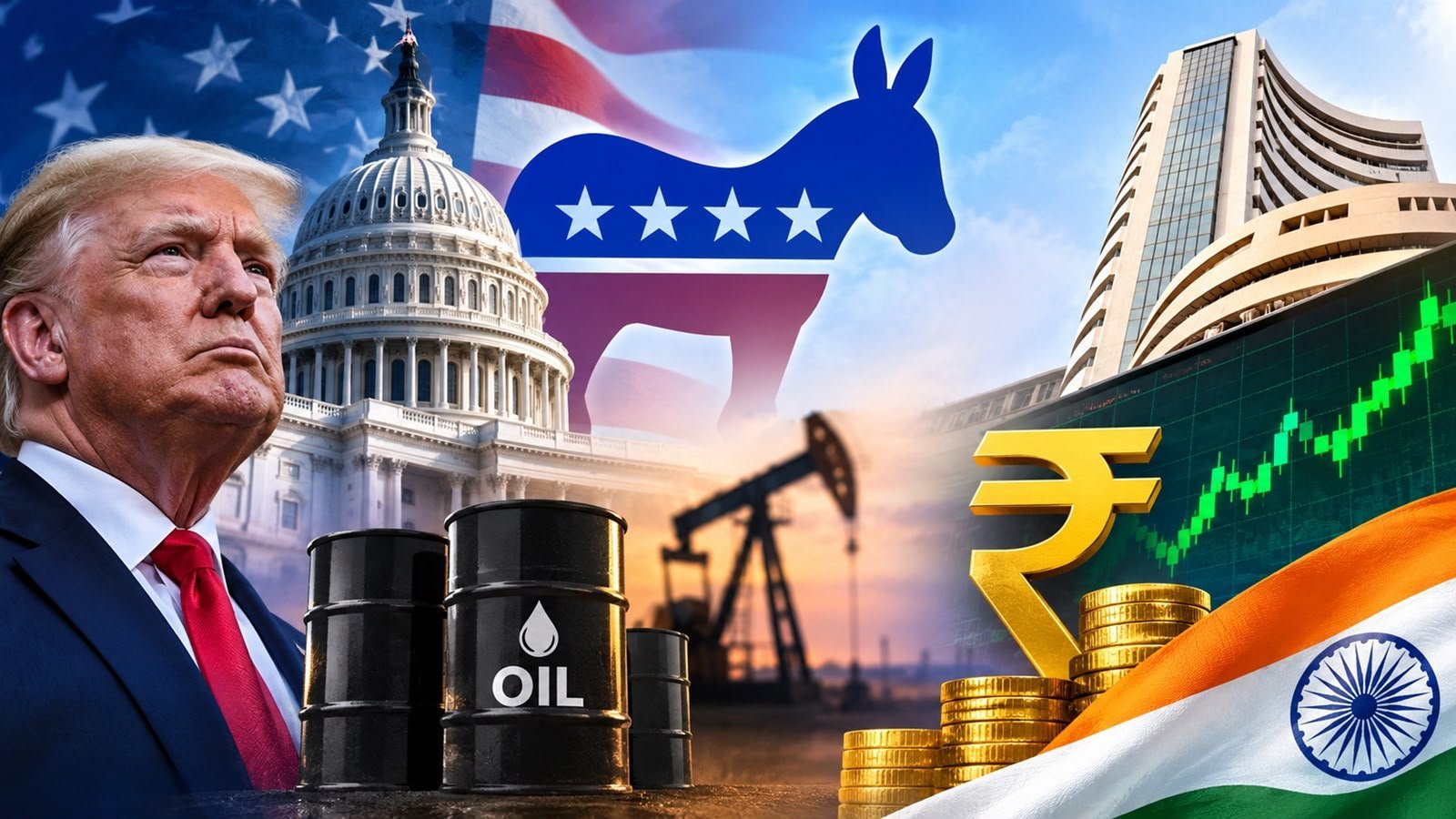
Great AI Rotation 2026: The US midterm elections are another important source of uncertainty for global markets.
Investors are watching the outcome because political changes can influence government spending, taxation, trade policy, regulation and the broader economic outlook.
However, the impact should not be oversimplified.
Political gridlock can sometimes limit major policy changes, but it does not automatically create a stable environment for every industry.
Markets will continue to respond to economic growth, corporate earnings, inflation, interest rates and geopolitical developments.
For Indian investors, the indirect impact may be particularly important.
According to market analysis cited by Reuters and other financial publications, oil prices, the US dollar and bond yields remain important channels through which US political developments can affect Indian equities.
The key takeaway is that investors should not build an investment strategy around election predictions alone.
Great AI Rotation 2026: The market rotation story becomes more interesting when we look at the sectors that may benefit from investors searching for stability, earnings visibility and reasonable valuations.
These sectors are not guaranteed winners. Their performance will depend on business fundamentals, valuations and economic conditions.
Fast-moving consumer goods companies sell products that people continue buying even when economic conditions become uncertain.
These include packaged foods, beverages, personal care products, household essentials and everyday consumer products.
The business model is different from that of high-growth technology companies.
A consumer staples company may not promise explosive growth. But it can benefit from regular demand, established distribution networks and brand loyalty.
Investors following the Indian market may examine businesses such as:
The important point is not to buy these companies simply because they belong to a defensive sector.
Valuation still matters.
A high-quality business purchased at an excessive price can deliver disappointing returns, even when its earnings remain stable.
Healthcare is another sector investors often study during periods of uncertainty.
Demand for medicines, medical treatment and healthcare services is influenced by long-term demographic and health needs, rather than only short-term economic growth.
This can make certain healthcare businesses less sensitive to economic cycles.
The healthcare sector is not risk-free.
Investors should examine regulatory approvals, research and development spending, product concentration, pricing pressure, patent expirations and export exposure.
In pharmaceuticals, one successful product does not guarantee that a company’s earnings will remain strong for years.
As traditional financial markets become more sensitive to valuation and funding conditions, investors are also discussing alternative asset classes.
Private credit refers to lending provided outside traditional public bond markets, often through private funds and specialised lenders.
Real assets include infrastructure, property and other assets connected to physical economic activity.
Investors may be attracted to:
However, private credit is not automatically safer than public markets.
It can involve limited liquidity, credit risk, valuation uncertainty, borrower defaults and complex fee structures.
Retail investors should understand the product, lock-in period, underlying borrowers and regulatory protections before investing.
A traditional barbell strategy combines two different types of investments: relatively safer assets on one side and higher-risk investments on the other.
The reverse barbell idea discussed in this market context focuses on avoiding excessive concentration in expensive, speculative growth trades while prioritising quality, financial strength and selective growth opportunities.
In simple terms, investors may look for businesses that have:
This does not mean completely avoiding technology.
AI remains a structural growth opportunity. The question is whether investors can find businesses benefiting from AI without paying unreasonable prices or taking excessive concentration risk.
One of the most interesting developments is the difference between index performance and individual stock performance.
A market index can remain strong because a relatively small number of large companies carry significant weight.
Meanwhile, many individual stocks can experience substantial declines.
The Goldman Sachs analysis highlighted this disconnect, with around 60% of S&P 500 constituents reportedly in bear market territory even as the index remained close to its record high.
It means looking beyond index-level performance.
Investors should examine:
A strong index does not necessarily mean every stock is performing well.
Similarly, a correction in some technology stocks does not automatically mean the entire market is entering a bear market.
The broader picture matters.
India’s stock market has its own drivers, including domestic consumption, earnings growth, interest rates, government spending and foreign investment flows.
However, global capital movements can influence Indian markets through currency movements, bond yields, foreign portfolio investments and risk appetite.
Investors may consider studying companies across:
Sector What to evaluate
FMCG Brand strength, volume growth, pricing power
Healthcare Product pipeline, margins, regulatory risks
Banking Asset quality, credit growth, capital adequacy
Infrastructure Order book, execution, debt levels
Manufacturing Demand, capacity utilisation, operating margins
IT services AI adoption, client spending, revenue visibility
The objective should be to identify businesses with sustainable earnings, not merely sectors currently receiving market attention.
There is no single strategy that works for every investor.
But during periods of market uncertainty, a disciplined approach becomes particularly important.
A decline in technology stocks does not automatically invalidate the long-term AI opportunity.
Investors should reassess business fundamentals, valuations and their original investment thesis rather than reacting emotionally to daily headlines.
For investors who already have a long-term investment plan, systematic investing or staggered accumulation can reduce the pressure of trying to identify the perfect entry point.
However, it does not eliminate the risk of losses.
A portfolio heavily concentrated in a few AI or technology stocks may carry more risk than its index performance suggests.
Reviewing sector exposure, individual stock weights and valuation concentration can help investors understand their actual risk.
Strong earnings, healthy cash flow, manageable debt and competitive advantages are more meaningful than short-term market narratives.
Defensive stocks can also fall. Midcap and smallcap stocks can be volatile. Alternative investments can have liquidity and credit risks.
Portfolio allocation should reflect the investor’s financial goals, investment horizon and ability to tolerate losses.
The AI revolution is not over.
Artificial intelligence could transform industries, improve productivity and create entirely new business opportunities.
But markets eventually move beyond excitement.
Investors begin asking harder questions about profitability, capital allocation, valuation and the ability to convert growth into cash.
That is what makes November 2026 an interesting period to study.
The emerging rotation towards defensive stocks, value sectors and financially stronger businesses suggests that market leadership may become broader and more selective.
For investors, the lesson is simple:
Do not confuse a powerful investment theme with an attractive investment price.
The next opportunity may not necessarily be in the most talked-about stock. It could be in a strong business that has been overlooked, has consistent earnings and is trading at a reasonable valuation.
In a market where capital is becoming more selective, financial discipline may matter more than chasing the next big story.
Disclaimer: This article is for educational purposes only and is not investment advice. All investments involve risk, including possible loss of capital. Please conduct your own research or consult a qualified financial adviser before making investment decisions.
The Great AI Rotation describes a potential shift in investor capital from highly valued AI and technology stocks towards other sectors offering stronger cash flows, more reasonable valuations and greater earnings stability.
Investors are increasingly evaluating the cost of AI infrastructure, rising capital expenditure, debt financing, free cash flow and the time required for companies to generate returns from their investments.
Defensive stocks are shares of companies whose products or services tend to experience relatively stable demand during different economic conditions. FMCG, healthcare and certain utility businesses are commonly considered defensive sectors.
FMCG, healthcare, pharmaceuticals, selected banking businesses, infrastructure and financially strong manufacturing companies may attract investor interest. However, individual stock valuations and fundamentals remain important.
Not necessarily. AI continues to have long-term growth potential. The current debate is increasingly about valuations, capital spending, profitability and which companies can generate sustainable returns from AI.
There is no universal answer. Investors should consider their goals, time horizon, risk tolerance, portfolio concentration and the fundamentals of individual businesses rather than making decisions based only on short-term market trends.


One thought on “The Great AI Rotation: Why Investors Are Shifting Towards Defensive Stocks and Value Sectors in November 2026”