 11
Sensex rally today: The Indian stock market has given investors a reason to smile after several sessions of strong buying.
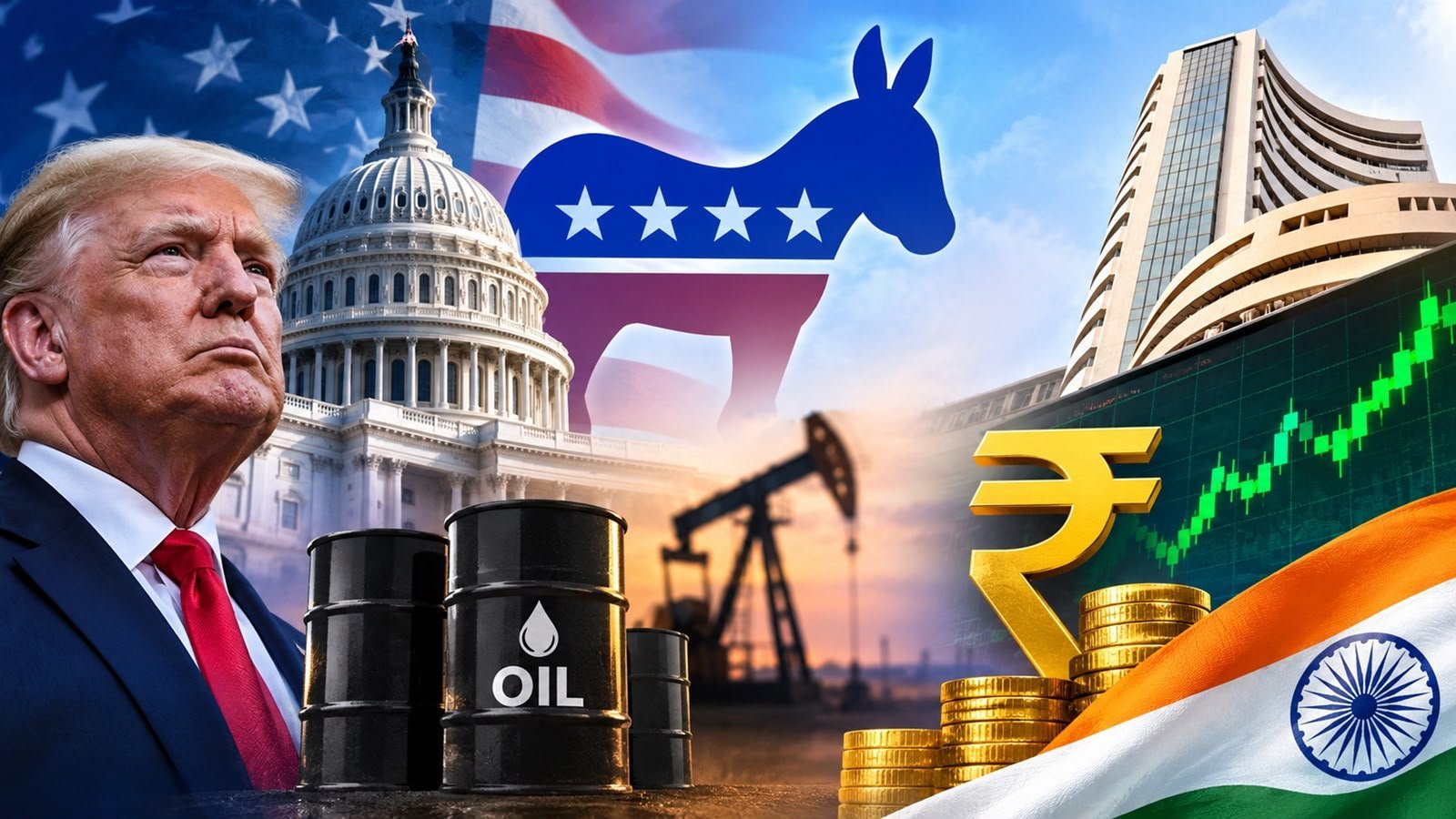
The Sensex and Nifty 50 have continued their upward movement, supported by falling crude oil prices, renewed foreign investor interest and improving global sentiment following the US midterm elections.
But what is actually driving this rally?
Is it a temporary reaction to global news, or could it signal a bigger change in market sentiment?
For Indian investors, understanding the reasons behind the rally is more important than simply watching the indices move higher.
Let’s examine the major factors driving the stock market today and what they could mean for your portfolio.
Indian equities have extended their recent recovery as several positive developments come together.
The major reasons behind the rally include:
According to Reuters, the Nifty 50 and Sensex had already gained approximately 5.6% over five sessions leading into Thursday’s trading. Foreign investors also purchased Indian equities worth ₹7,284 crore on Wednesday, November 4.
These developments have strengthened confidence in Indian equities after a period of uncertainty.
Also Read – US Midterm Election 2026: Renewable Energy Stocks Rally as AI Data Centre Stocks Face Pressure
One of the biggest international developments influencing financial markets is the outcome of the US midterm elections.
The Democratic Party’s gains in Congress have increased expectations that the US administration could face greater political pressure to reconsider its approach to the conflict involving Iran.
For global investors, the possibility of reduced geopolitical tensions is significant.
Why?
Because geopolitical conflicts can disrupt oil supplies, increase shipping costs and create uncertainty across financial markets.
If diplomatic negotiations make progress, investors may begin moving away from defensive positions and towards assets that could benefit from improving economic conditions.
India is particularly sensitive to global developments involving energy prices.
A more stable international environment could potentially: (Sensex rally today)
However, the election result alone does not guarantee peace or lower oil prices. Markets are reacting to expectations, and those expectations can change quickly.
Crude oil is one of the most important factors influencing India’s economy.
India imports a substantial share of its crude oil requirements. When international oil prices rise, the country must spend more money on imports.
When oil prices fall, the opposite can happen.
Reuters reported that Brent crude declined approximately 8.7% in the previous session, falling to around $94 per barrel amid hopes of progress towards easing the Iran conflict.
This sharp decline has become an important positive factor for Indian markets.
How lower crude prices affect India
| Economic factor | Potential impact of falling crude |
| India’s import bill | May decrease |
| Inflation | Could ease |
| Indian rupee | May receive support |
| Government finances | Potential relief |
| Corporate operating costs | May decline for some businesses |
| Consumer spending | Could benefit from lower inflation |
Lower crude prices can also provide relief to businesses that depend heavily on fuel, transportation and energy.
Oil marketing companies: HPCL, BPCL and Indian Oil Corporation could benefit from lower crude costs, depending on inventory movements, refining margins and fuel pricing.
Aviation: Lower fuel prices could provide relief to airlines because aviation turbine fuel represents a significant operating expense.
Paint companies: Lower crude prices can reduce costs for certain petroleum-based raw materials.
Logistics and transportation: Falling diesel prices, if passed through domestically, could improve cost conditions for transport-dependent businesses.
Manufacturing: Companies using energy-intensive processes may benefit from lower input costs.
However, lower crude is not an automatic guarantee of higher profits. Currency movements, refining margins, inventory valuation and domestic fuel prices also matter.
Foreign Institutional Investors have been an important part of the recent market recovery.
After periods of heavy selling, foreign investors have started returning to Indian equities.
According to market reports, FIIs purchased approximately ₹7,284 crore worth of Indian equities on November 4, 2026. This was their fourth consecutive session of buying.
This development matters because foreign investors have substantial influence over market liquidity and sentiment.
Several factors may be influencing their decisions:
Domestic Institutional Investors (DIIs), including mutual funds and insurance companies, may not always follow the same direction as foreign investors.
When FIIs buy and DIIs sell, the market can still rise, but the strength and sustainability of the rally may depend on how long foreign inflows continue.
Investors should track both groups rather than relying on one day’s data.
The Indian rupee is another important part of this market story.
When crude oil becomes expensive, India needs more dollars to pay for imports. This can put pressure on the rupee.
When crude prices decline, the demand for dollars to pay for oil imports may reduce.
Reuters reported that the rupee was expected to strengthen following the recent decline in crude oil prices, although the sustainability of that recovery depends on global conditions.
A relatively stable or stronger rupee could benefit:
However, exporters may face a different situation because a stronger rupee can reduce the value of their overseas earnings when converted into rupees.
This is why currency movements affect different sectors differently.
The recent recovery has improved sentiment, but investors should avoid making decisions based only on the market’s opening movement.
A gap-up opening can create excitement. It can also attract short-term traders who may book profits quickly.
Instead of chasing stocks after sharp gains, investors should examine the following factors.
Companies with strong earnings growth, manageable debt and consistent cash flow may be better positioned to withstand volatility.
A good company can still become a risky investment if its share price rises too far ahead of its earnings.
A sustained trend of institutional buying can provide stronger confirmation than a single day’s inflow.
Falling crude may support some businesses while creating different challenges for others.
Short-term market movements are influenced by headlines, expectations and trading activity. Long-term returns depend more heavily on business performance, earnings growth and the price paid for an investment.
The Nifty 50’s recent recovery has brought attention to the 24,000–24,300 zone.
Market participants will be watching whether the index can sustain its gains and move beyond immediate resistance levels.
For investors and traders, the important indicators include:
| Indicator | Why it matters |
| Nifty 50 near 24,300 | Psychological and technical zone to monitor |
| Brent crude below $100 | Important for India’s inflation and import outlook |
| FII cash-market activity | Indicates foreign investor sentiment |
| Indian rupee movement | Reflects currency and macroeconomic pressure |
| India VIX | Helps assess market volatility expectations |
| Corporate earnings | Provides fundamental support to valuations |
These are monitoring points, not guaranteed targets. Technical levels can change as new information enters the market.
This is the question many investors are asking.
The answer depends on whether the positive developments continue to support the market.
A rally does not move upward indefinitely. Even healthy bull-market movements experience corrections.
Investors should therefore avoid assuming that every dip is an opportunity or every rally is a signal to buy.
The Sensex is rising amid improving global sentiment, falling crude oil prices, foreign institutional buying and expectations of easing geopolitical tensions following the US midterm elections.
India imports a large share of its crude oil. Lower prices can reduce import costs, ease inflationary pressure, support the rupee and improve operating conditions for some businesses.
Foreign Institutional Investors purchased approximately ₹7,284 crore worth of Indian equities on November 4, according to market reports.
Oil marketing companies such as HPCL, BPCL and Indian Oil, along with airlines, paint companies and logistics businesses, may benefit under favourable conditions. Individual company fundamentals and valuations still need to be assessed.
That depends on your investment horizon, financial goals, risk tolerance and portfolio allocation. Investors should avoid making decisions based solely on a sudden market rally and should evaluate company fundamentals and valuations.
Yes. Markets remain sensitive to geopolitical developments, crude oil prices, institutional flows, currency movements and earnings. A positive trend can reverse if these factors change.
The Indian stock market’s recovery is being supported by several developments rather than one isolated event.
Falling crude oil prices could provide relief to India’s economy. Renewed FII buying may improve liquidity and sentiment. Meanwhile, the US midterm election outcome has changed expectations around geopolitics and global markets.
But investors should remember one important point.
A rising market is not the same as a risk-free market.
The smarter approach is to follow the fundamentals, understand the reasons behind market movements and avoid making investment decisions driven by excitement or fear.
The coming sessions will reveal whether these positive developments can translate into sustained buying or whether investors begin booking profits after the sharp recovery.
Disclaimer: This article is for educational and informational purposes only. It is not investment advice or a recommendation to buy or sell any security. Please consult a SEBI-registered financial adviser before making investment decisions.