
 11
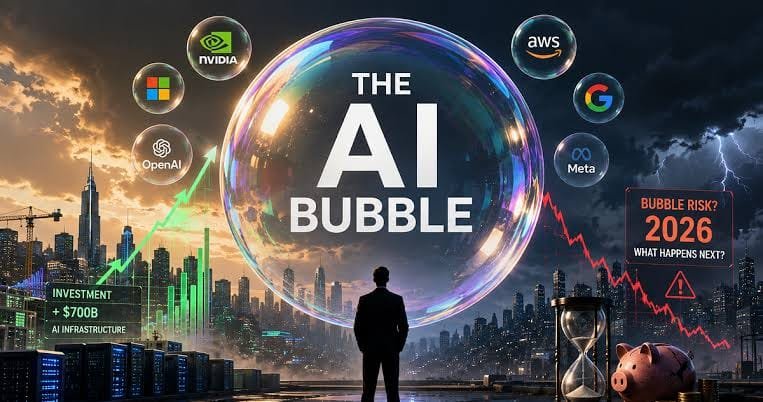
AI bubble 2026: Everyone wanted a piece of the AI revolution.
Now, everyone wants to know who is going to pay for it.
On October 30, 2026, Wall Street witnessed another brutal technology sell-off. The Nasdaq fell approximately 2.9%, marking its steepest single-day decline since June. Intel plunged nearly 29%, while Amazon’s financial results and spending plans raised fresh concerns about the cost of artificial intelligence.
The question investors are asking is no longer whether AI will change the world.
It is whether the companies spending hundreds of billions of dollars on AI will actually make enough money to justify those investments.
And honestly, that is a very reasonable question.
For the past few years, artificial intelligence has been the biggest growth story in global markets.
Microsoft, Amazon, Google, Meta and other technology giants have been investing heavily in AI infrastructure, data centres, advanced chips and computing power.
The logic was simple.
Build the infrastructure first. Capture the market later.
But investors are now beginning to question the second half of that equation.
Amazon has indicated capital expenditure could reach approximately $220 billion in 2026. Meanwhile, concerns about cash flow and the timing of returns have increased.
Intel’s disappointing outlook added another layer of uncertainty. The company is facing manufacturing challenges, weaker PC demand and substantial investment requirements.
These developments have pushed investors to reconsider the relationship between AI spending and actual business performance.
AI capital expenditure is no longer automatically being treated as good news.
Let’s be clear on AI bubble 2026
A falling stock price does not automatically mean a company is failing. Similarly, a growing industry does not mean every company operating within it is worth buying.
The AI industry has enormous long-term potential.
Businesses are already using AI for customer service, software development, research, automation, marketing and operational efficiency.
However, there is a difference between a technology becoming valuable and investors making money from every company associated with it.
During the dot-com bubble, the internet was real. Its commercial potential was real. But the valuations of many internet companies were completely disconnected from their financial reality.
Something similar could happen with AI.
The technology might transform industries while several AI stocks still deliver disappointing returns.
That is the distinction investors need to understand.
If companies continue investing aggressively in AI infrastructure but revenue growth fails to keep pace, investors will eventually question the business model.
Investors have spent years rewarding companies for announcing AI partnerships, new products and infrastructure investments.
The next phase could be different.
Companies may need to demonstrate measurable earnings, positive cash flow and sustainable returns rather than simply announcing bigger investments.
AI companies are competing aggressively.
As more businesses develop similar capabilities, pricing pressure could increase. The companies spending the most today may not necessarily become the most profitable tomorrow.
The Indian stock market is not isolated from global technology trends.
Foreign institutional investors, global risk appetite and technology valuations can influence Indian equities even when domestic fundamentals remain relatively strong.
For retail investors, the biggest mistake would be making emotional decisions based on one trading session.
Instead, consider these practical steps:
The objective is not to predict the exact bottom.
It is to build a portfolio that can survive being wrong about market timing.
AI bubble 2026: The biggest winners of the AI revolution may not be the companies currently attracting the most attention.
They could be businesses that quietly use artificial intelligence to reduce costs, improve productivity and increase margins.
A manufacturing company using AI to reduce operational waste might create more sustainable value than a technology company spending billions without a clear path to profitability.
Investors need to look beyond the excitement.
Because in the stock market, a great technology and a great investment are not always the same thing.
The current AI sell-off does not prove that artificial intelligence is a bubble.
But it does suggest that investors are becoming more selective.
The easy money made by buying every AI-related stock may be behind us. The next phase will demand better financial analysis, realistic valuations and a closer examination of cash flow.
AI could still become one of the most important technological revolutions in history.
The question is whether investors are paying a reasonable price to participate in it.
And that is where the real opportunity begins.