
 11


Indian stock market today: There is something interesting happening in the Indian stock market.
Global technology stocks are under pressure. Wall Street has witnessed a sharp sell-off. Investors are questioning whether massive artificial intelligence investments will deliver the returns companies have promised.
Yet the Indian market is showing a different picture.
Domestic IT stocks have demonstrated resilience, even as mid-cap and small-cap stocks face profit-booking and valuation pressure.
This divergence is worth understanding.
Because when global markets become uncertain, investors often make the mistake of treating every market movement as the same story.
It isn’t.
The October 30 sell-off in the United States was driven largely by concerns around technology earnings, AI infrastructure spending and future profitability.
The Nasdaq declined nearly 3%, while Intel suffered an extraordinary fall following its earnings outlook.
These developments matter to Indian investors for several reasons.
First, foreign institutional investors may reduce exposure to emerging markets when global risk appetite weakens.
Second, Indian companies with international revenue exposure can face uncertainty if global demand slows.
Third, global volatility can influence currency movements, capital flows and overall investor sentiment.
However, none of these factors automatically mean Indian companies are fundamentally weaker.
The important distinction is between a global market correction and a deterioration in domestic business performance.
Also Read – US Market Crash: What Could Happen to Indian Stocks on Monday?
The IT sector has been navigating uncertainty around global technology spending, AI adoption and client budgets.
Interestingly, the current AI debate creates both risks and opportunities for Indian IT companies.
On one side, businesses may reduce traditional technology budgets as they spend more on AI infrastructure.
On the other, enterprises need implementation, integration, cybersecurity, cloud migration and AI consulting services.
Indian IT companies could benefit if they successfully position themselves as partners in this transition.
But investors should not assume that every IT company will benefit equally.
The ability to convert AI demand into actual revenue growth, operating margins and cash flow will matter more than announcements.
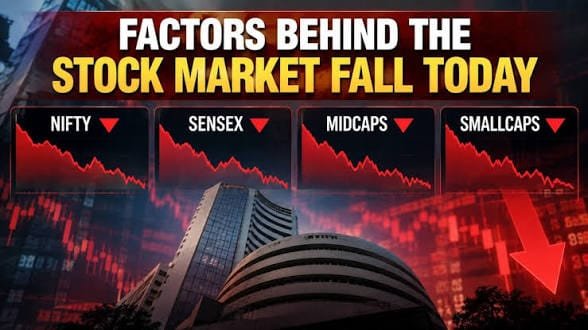
One of the most important developments in the Indian stock market is the pressure on mid-cap and small-cap shares.
For several months, investors have been attracted to companies offering rapid growth and seemingly unlimited potential.
But higher valuations leave less room for disappointment.
When liquidity becomes tighter or global sentiment weakens, these stocks can experience sharper corrections than large-cap companies.
This is not necessarily a bad thing.
A correction can remove excessive speculation and create healthier market conditions.
The problem is that investors who entered without understanding valuation risk may panic when prices fall.
A good company bought at an unreasonable price can still become a poor investment.
Corporate earnings should be the foundation of investment decisions.
Companies such as NTPC and Muthoot Finance have attracted attention for their reported year-on-year profit growth in the second quarter.
But investors must look beyond headline profit numbers.
Ask these questions: (Indian stock market today)
These questions matter far more than whether a stock rises 3% or falls 5% in one session.
The current environment requires patience rather than aggressive prediction.
For long-term investors
Continue evaluating businesses based on earnings, management quality, balance sheets and valuations.
A market correction can create opportunities, but only when the underlying investment thesis remains intact.
For new investors
Avoid investing your entire available capital at once simply because the market has declined.
Gradual investing can reduce the pressure of trying to identify the perfect entry point.
For traders
Volatility can create opportunities, but it also increases the probability of sudden reversals.
Risk management, position sizing and stop-loss discipline become particularly important.
For small-cap investors
Review concentration carefully.
A portfolio containing multiple small-cap stocks may appear diversified while still carrying substantial exposure to the same underlying risks.
A particular index level does not independently determine whether a market is cheap.
Nifty at 23,000 could represent an attractive opportunity under one earnings scenario and an expensive valuation under another.
The answer depends on earnings expectations, interest rates, economic growth and investor positioning.
Investors should avoid turning round numbers into automatic buying signals.
The better approach is to evaluate the market using a combination of valuation, earnings growth and risk tolerance.
Indian stock market today: The Indian stock market is navigating an environment where global uncertainty and domestic opportunities coexist.
IT sector resilience, strong corporate earnings and domestic economic activity may support selected companies.
At the same time, mid-cap and small-cap valuations deserve careful attention.
The market does not reward investors for being optimistic all the time.
It rewards investors for understanding what they own, what they are paying and what could go wrong.
In uncertain markets, discipline is not a boring strategy.
It is a competitive advantage.




One thought on “Indian Stock Market Today: Nifty, IT Stocks and the Reality Behind Market Resilience”