
 11
Binance hack 2026: For years, cryptocurrency investors have been told that blockchain technology is secure.
And technically, blockchain networks can be extremely secure.
But here is the uncomfortable reality.
The security of the technology does not automatically guarantee the security of the company, platform or wallet holding your money.
The reported $6.3 billion Binance security breach on October 30, 2026, has brought this distinction back into focus.
The incident has triggered concerns across the cryptocurrency industry, raising serious questions about exchange security, digital asset custody and the risks investors may be overlooking.
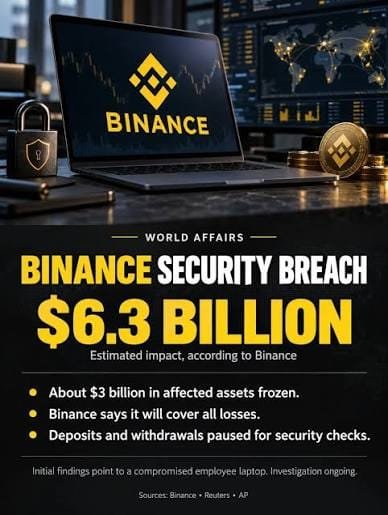
Binance hack 2026: Binance, one of the world’s largest cryptocurrency exchanges, reported a complex security incident involving an estimated $6.3 billion in affected assets.
Initial investigations suggested a compromised internal device may have played a role. However, subsequent reports indicated that investigators were examining additional security weaknesses and possible failures involving wallet infrastructure and transaction approvals.
The exchange announced that it would cover the losses and arranged approximately $6.34 billion in funds and assets to address the incident.
Reports also indicated that industry partners had frozen around $3 billion in potentially affected assets.
Binance later reported that it had replenished approximately $6 billion of the affected assets, although recovery and verification efforts were continuing.
These developments are significant.
But investors should understand that the incident is still evolving, and early reports about the attack should not be treated as a complete technical investigation.
Also Read – Indian Stock Market Today: Nifty, IT Stocks and the Reality Behind Market Resilience
Many people assume cryptocurrency risk comes primarily from market volatility.
Bitcoin falls 10%. Ethereum declines. A smaller token loses 50%.
These are visible risks.
Security risks are different.
A cyberattack can affect assets even when market prices remain stable. It can also disrupt withdrawals, damage confidence and create uncertainty about how an exchange manages customer funds.
The Binance incident highlights three major issues.
Exchanges manage complex infrastructure involving employees, devices, cloud systems, software and transaction approvals.
A weakness in one part of the system can potentially affect much larger pools of assets.
Hot wallets remain connected to systems that facilitate transactions.
They are necessary for operational liquidity, but their accessibility introduces additional security considerations.
Exchanges must carefully manage wallet exposure, signing procedures, monitoring and transaction limits.
Proof of reserves can help investors understand whether an exchange holds certain assets.
However, reserve verification alone does not necessarily demonstrate that every internal system is secure, that liabilities are fully accounted for or that assets cannot be exposed to operational failures.
Investors need to understand the difference.
Not necessarily.
Blockchain technology continues to have legitimate applications in payments, financial infrastructure, tokenisation and digital ownership.
But the cryptocurrency industry has a trust problem.
The industry often promotes decentralisation while millions of users depend on centralised exchanges for trading, custody and account access.
This creates a contradiction.
Investors may own decentralised assets but store them through organisations that operate much like traditional financial intermediaries.
That means exchange governance, cybersecurity, transparency and operational controls matter enormously.
Exchange convenience should not be confused with long-term custody.
Consider whether your holdings require continuous access to trading or whether some assets should be held separately.
Hardware wallets and self-custody solutions can reduce certain exchange-related risks.
However, they introduce other responsibilities, including protecting private keys and recovery phrases.
Losing access to those credentials can mean losing access to assets.
Use unique passwords, passkeys or strong authentication methods where available.
Avoid clicking suspicious links or responding to unsolicited messages claiming to be exchange support.
Review reserve disclosures, security communications, withdrawal policies and the exchange’s track record.
Do not rely exclusively on promotional claims or social media reassurance.
Crypto assets can experience substantial volatility and operational risks.
An investment decision should reflect your financial situation, not the fear of missing out.
Binance hack 2026: Markets have recovered from previous exchange failures and security incidents.
But recovery should not be confused with the absence of consequences.
A major breach can accelerate regulatory scrutiny, encourage users to move assets and force exchanges to strengthen their infrastructure.
It may also lead investors to differentiate between platforms based on security practices rather than trading volume alone.
The long-term impact will depend on the quality of the investigation, the actual recovery of assets and the exchange’s ability to demonstrate meaningful improvements.
Binance hack 2026: The Binance incident should not be viewed simply as another dramatic cryptocurrency headline.
It is a reminder that digital asset ownership requires more than choosing the right token.
Investors must also understand where their assets are held, how transactions are authorised and what happens when a platform experiences a security failure.
The future of cryptocurrency depends not only on innovation.
It also depends on trust.
And trust is built through transparency, accountability and security that works when it is tested.




One thought on “Binance $6.3 Billion Crypto Hack: A Wake-Up Call for the Entire Cryptocurrency Industry”